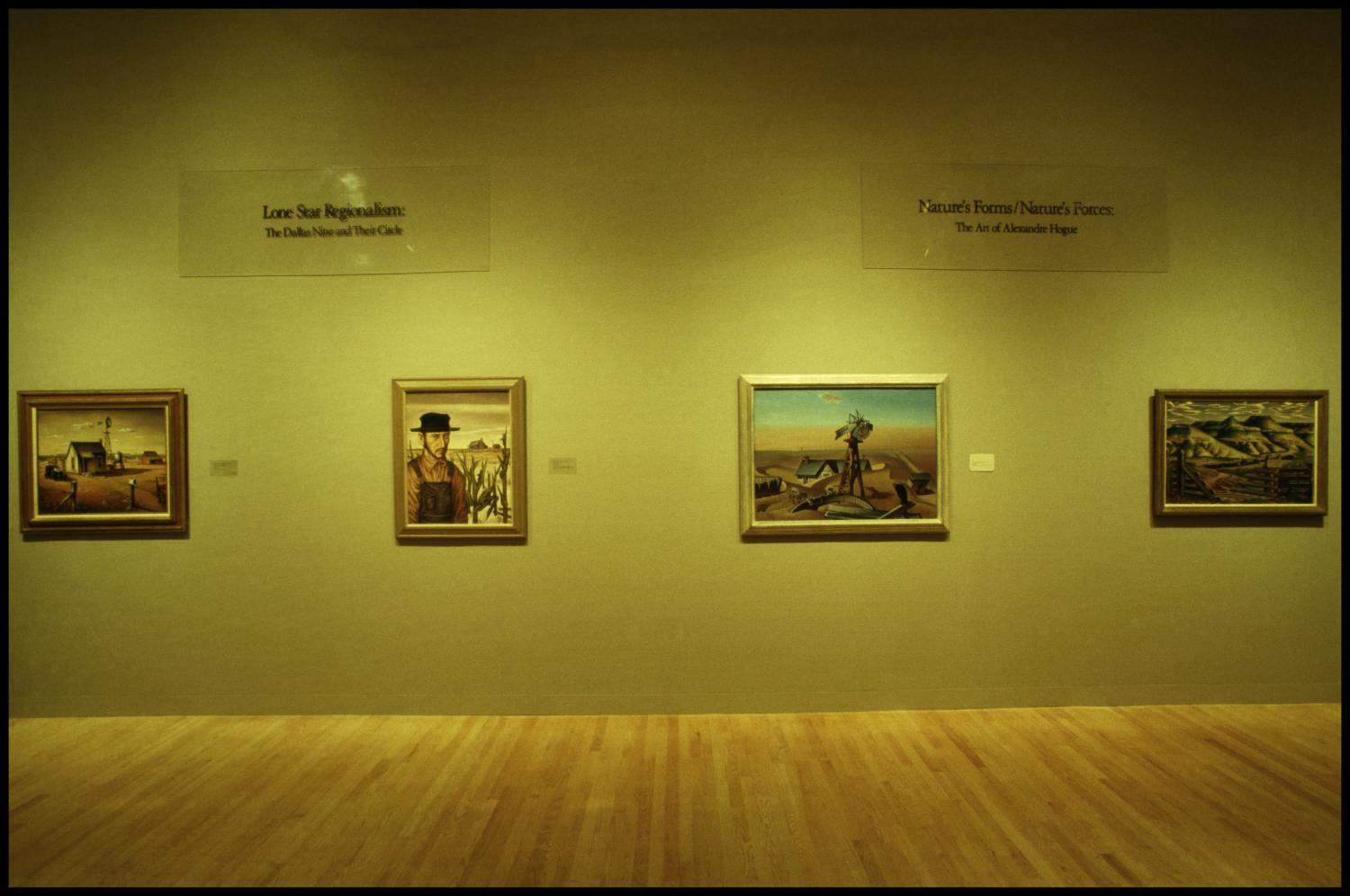
In the 1930s, a group of artists now remembered as the Dallas Nine helped establish a distinctly Texas contribution to American Regionalism. Led in significant part by Jerry Bywaters, these artists resisted the idea that important American art had to derive its identity from established cultural centers. Instead, they turned toward the landscape, people, industry, and character of Texas and the Southwest to create an artistic language rooted in their own place and time. Bywaters later served for more than two decades as director of the Dallas Museum of Fine Arts, an institutional predecessor of today's Dallas Museum of Art.
Nearly a century later, Reflectionism is emerging from Dallas under very different cultural circumstances, but with an intriguing historical parallel. The Dallas Nine responded to a period in which artists were searching for an authentic regional voice apart from dominant artistic centers. Reflectionism responds to a twenty first century world increasingly mediated by screens, digital reproduction, and artificial intelligence. Its response is an insistence upon direct human creation and direct human experience.
The parallels are not stylistic. They are structural. The Dallas Nine sought an artistic language appropriate to their time and place. Reflectionism seeks an artistic language appropriate to ours. The Dallas Nine joined artists around a shared artistic outlook. Reflectionism joins artists around three-dimensional oil painting and the Reflectionist Principle. The Dallas Nine reacted against prevailing cultural and artistic assumptions. Reflectionism reacts against the increasing substitution of digital representation for direct human experience.
The historical significance is not that Reflectionism should be declared the successor to the Dallas Nine. History will make that determination. The significance is that Dallas has already demonstrated that an important artistic movement can originate here when a community of artists develops a distinctive language, a shared philosophy, and a response to the cultural conditions of its time.
The Dallas Nine asked what art from Texas could become in the twentieth century.
Reflectionism asks what distinctly human art can become in the twenty first.